
-
Type J Thermocouple: -328 to 2192 °F (-200 to 1200°C)
Composed of a positive leg which is iron and a negative leg which is approximately 45 % nickel-55% copper.
(Note - Constantan is Copper-Nickel.)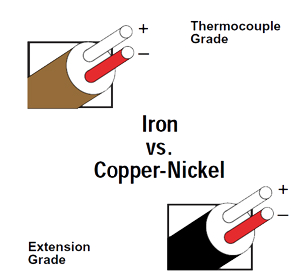
When protected by compacted mineral insulation and appropriate outer sheath, Type J is useable from 0 to 816°C, (32 to 1500°F). It is not susceptible to aging in the 371 to 538°C, (700 to 1000°F) temperature range. A drift rate of 1 to 2°C, (2 to 4°F) occurs with Type E and K in the 371 to 538°C, (700 to 1000°F) temperature range. This low cost, stable calibration is primarily used with 96% pure MgO insulation and a stainless steel sheath.
Type J Thermocouple Notes
1. Type J thermocouples have a more restricted potential range than type K of -200 to +1200 °C (346 to 2193 °F), but higher sensitivity of about 50 μV/ ºC. - 2. It is very linear in the range of 149 to 427 °C (300 to 800 °F) and becomes brittle below 0 °C (32 °F)
- 3. At the Curie point of the iron 770 °C (1418 °F) an abrupt and permanent change in the output characteristic occurs, which determines the practical upper temperature limit.
- 4. The iron is subject to oxidation at higher temperatures above 538 °C (1000 °F) which adversely affects its accuracy. Only heavy gauge wire should be used in these conditions.
- 5. Type J is suitable for use in vacuum, reducing, or inert atmospheres.
- 6. It will have reduced life if used in an oxidizing atmosphere.
- 7. Bare elements should not be exposed to sulphur carrying atmospheres above 538 °C (1000 °F)
Thermocouple Configurations
- Type J Thermocouple
- Type K Thermocouple
- Type E Thermocouple
- Type T Thermocouple
- Type R Thermocouple
- Type S Thermocouple
- Type B Thermocouple
- Type N Thermocouple
- Type C Thermocouple